Why Soccer Is the Language of Muslim Community
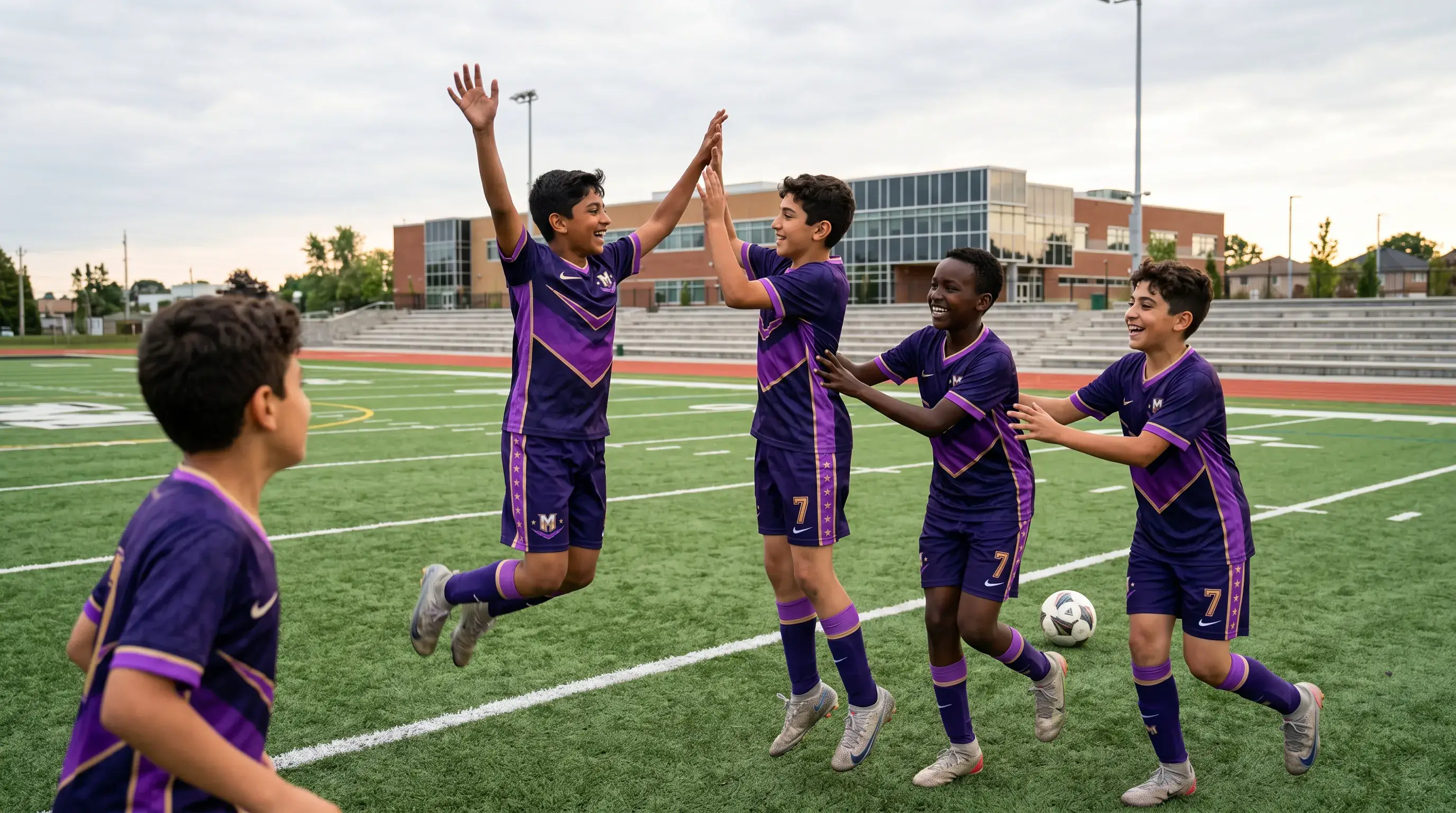
The mosque teaches us the words. The school teaches us the lessons. The kitchen at a family iftar teaches us the stories. Each of these places has its job, and each one is indispensable. But ask any parent who has watched a child grow up between the prayer hall and the math classroom, and they'll tell you: the hardest thing about raising a Muslim kid in Canada isn't teaching them what to believe. It's giving them a place to matchday it.
Belief needs a gym. Character needs repetition. And you cannot, it turns out, rehearse generosity in a lecture hall, or patience at a desk, or courage on a worksheet. You rehearse those things in the muscle and in the sweat, with other bodies around you, under conditions where the outcome is uncertain and the audience is real. That's why, when we set out to build Muslim Youths FC on a field in Hamilton, we didn't call it a mentoring program or a youth development initiative. We called it a soccer league. Because the sport wasn't incidental, it was the whole point.
What the mosque can't do, and what the field can
Mosques do sacred work. They hold the liturgy, the teachers, the elders, the continuity. Without them the community would fracture within a single generation, because memory doesn't survive without institutions. But mosques also have a structural limit: the child sits, and the teacher speaks, and the learning is mostly vertical. The kid is an audience to adults who know more than they do.
That is an essential relationship. It's also an incomplete one. Somewhere a child has to find out what they can actually do, what their own body feels like under pressure, whether they'll pass the ball when the selfish thing is easier, whether they'll shake a losing opponent's hand when they're eleven years old and want to cry. That's not a vertical learning. It's horizontal. It happens between the kid and their peers, with an adult nearby but not speaking.
Soccer is one of the most honest forms of horizontal learning a community can offer. You can't fake it. You can't perform it for a parent. The other nine kids on your side of the field will know immediately if you're generous with the ball or hoarding it, if you're calling their name to pass or keeping your eyes down, if you're the kid who runs back on defense even when you're exhausted or the kid who walks. Ninety minutes of a real match strips more pretense out of a child than ninety weeks of classroom Islam.
The ummah is a verb
There's a phrase you'll hear at every Muslim event in North America: the ummah. The community. The word is usually deployed as a noun, "our ummah," "the ummah is watching," "come support the ummah." But in its original Qur'anic usage the word is active. It's closer to that which stands together than to the group that exists. Ummah, properly understood, is not a category. It's a matchday.
Which means the ummah has to be built, not declared. You can't inherit it; you have to do it. And the way you do it is by putting yourself in the same room, or the same pitch, as people you didn't choose, and finding out whether you can cooperate anyway. That is the hardest and most important thing a Muslim child has to learn in a country like Canada, where so many of the easier social circles are carved by language, by school district, by income, by which cousin of which uncle has the bigger backyard.
Soccer breaks that. Two kids end up on the same team because the coach wrote their names on a clipboard in March. They come from different mosques, different jobs their parents hold, sometimes even different sects, the Sunni kid and the Shia kid, the Somali family and the Pakistani family, the kid whose dad is a taxi driver and the kid whose mom is a doctor. None of that matters at kickoff. The only thing that matters is whether they can find each other in space and get the ball from their feet to the back of the opposing net. We've explored the sectarian piece of this in its own essay. The point here is broader: the field collapses social hierarchies that the rest of childhood carefully preserves.
Why the adults need it too
Almost everything we've said so far is about the kids, but we'd be dishonest if we didn't name the other half of the equation. The parents need this too. Maybe more than the kids do.
Every Wednesday or Saturday, roughly two hundred adults show up at Bishop Ryan and stand along a sideline together for two hours. They're all Muslim. They don't all know each other. Some of them came to Canada last year, some came thirty years ago. Some pray at the mosque on the east end, some at the one on the west end. Most of them, if you asked, would say they wish they knew their community better but never found a way in. And then their kid joined MYFC, and the way in turned out to be nothing more complicated than watch the match, talk about the weather, offer someone a samosa from your cooler bag.
This is how community is rebuilt. Not at the grand banquet, not at the fundraiser, not at the conference hall. At the quiet repetition of showing up next to the same people every Wednesday and Saturday for eleven weeks in a row, with nothing to prove and a shared stake in who's winning the match. By the end of a season, the sidelines at Bishop Ryan know each other's names. By the end of a second season, they know each other's families. That's the ummah, built with our own hands.
The case for sport, plainly
We think Muslim parents in Canada are under-served by institutions that understand the spiritual weight of sport. Too many community offerings split the difference: Qur'an class OR soccer matchday, but never the same organization running both, never a coach who tells a nine-year-old to take the shot in Arabic and English and a hand-sign the kid understands. Soccer gets treated as recreation, an afterthought you enroll in if the schedule allows.
That's upside down. Sport is not recreation, not at ten. At ten, sport is character formation with a whistle. It's where kids learn to handle frustration, deal with unfair calls, support a teammate who made a mistake, carry their own losses without turning mean. Those aren't soccer lessons. Those are the lessons of the ummah, rehearsed in a form young bodies can actually metabolize.
So when a Muslim parent in Hamilton asks us why we built a whole league instead of just running a weekend mentorship group, the honest answer is this: the league is the mentorship. The field is the classroom. The sport is the language. We didn't invent any of that. We just built a place where it could happen.
Come see it on a Wednesday or Saturday in June. Bring a chair. Bring a cooler. Stand on the sideline next to someone you've never met. That's where the work is.